Everything I know about Apocalypse Now, I learned from Animaniacs
90s (and 70s) throwback
Unclear and Present Danger, the podcast hosted by Jamelle Bouie and Substack’s own John Ganz, recently posted an episode devoted to Apocalypse Now. Great listen, because of course it is—Apocalypse Now is one of the richest, densest cinematic texts ever produced. Far more than The Godfather, for instance. There is always something more to say about the movie, more to discover in its new cuts and editions.
The episode compelled me to look through my files. Years ago, I wrote an essay partially about Apocalypse Now, inspired by a manuscript I once worked on. That manuscript never took off, and the commissioning editor ended up passing on this piece. Appropriate enough, given the essay’s theme of unfinished, unfinishable work. So I thought I would finally place the essay here, for the benefit of my dear readers. I know you guys are always on the lookout for a hit of nostalgia and/or existential dread. Enjoy!
Rosebud, whispers Charles Foster Kane just before he dies. The snow globe he was cradling in his hand rolls off of his deathbed and falls to the floor, shattering. As a nurse comes in and draws a shroud over Kane’s body, we’re left to wonder: what was the meaning of his final word? Is it a key that will unlock the mystery at the heart of the lonely tycoon’s life?
Orson Welles waits until the very end of his masterpiece, Citizen Kane, to reveal the significance of the protagonist’s dying word. But you already know what it is, even if you’ve never seen the movie, even if you aren’t fully aware that you have this piece of information on file. ‘Rosebud,’ in fact, is—and I suppose I’m contractually obligated to announce ‘spoiler alert’ here—the name of Kane’s beloved childhood sled, the only thing he truly loved in his ambitious, isolated life. When you come to the end of the movie and see ‘Rosebud’ printed on the sled, you’ll ask yourself a question: how did I know that?
The answer has to do with your age. ‘Rosebud’ is a reference that popular culture that has been making for more than fifty years. If you’re like me, born in the early 80s, raised on Sesame Street and George H.W. Bush, you first heard about it from Animaniacs, a cartoon that was an afternoon staple for many a Millennial. The show was thick with running gags, right down to the opening theme song. (“It’s time for An-nami-niacs!”) The song introduced the characters and basic plot, as theme songs are meant to, but there was something different in every episode, a rotating joke in the song’s penultimate lyric. “Ani-maney, totally insaney,” the song went, and then there would be a brief gag before it concluded. One of these gags featured Yakko Warner standing in a wintry landscape, holding up a sled. Printed on it is, yes, the word ‘Rosebud.’ “Citizen Kane-y!” Yakko sings, then the regular song resumes. When I watched the movie, years later, and the film’s central mystery was revealed, all I could think of was a cartoon show that used to anchor the Fox KIDS lineup.
Animaniacs was my skeleton key to popular culture. Before The Simpsons, before Saturday Night Live, Yakko, Wakko and Dot were showing me what was funny, even if I didn’t understand why.
Animaniacs was the product of executive producer Steven Spielberg and the animation wing of his production company, Amblin Entertainment. The studio had experienced major success with Tiny Toon Adventures, a kind of Looney Tunes: The Next Generation, and they were looking for a different approach to the kids’ cartoon format. Tiny Toon Adventures was a fun show, with the episode set to the music of They Might Be Giants being a high water mark, but there was the sense that it was almost too faithful to its forebears. The characters were simply updates of the old Looney Tunes characters: wisecracking Bugs Bunny became wisecracking Buster Bunny, Daffy Duck became the brash yet insecure Plucky Duck, and Yosemite Sam the leisure-suited schoolyard bully Montana Max. Animaniacs was an attempt to recreate the anarchic joy of the old Looney Tunes gang in spirit more than word.
A clear touchstone from the “That’s all folks!” era is Duck Amuck, a six-minute classic of cartoon existentialism. As you’ll recall, the cartoon finds Daffy Duck being hounded by the very cartoonist who’s animating him. A pencil appears from beyond the frame and erases the ground Daffy is standing on, or redraws him as a freakish platypus, or simply removes the background entirely, leaving Daffy in an expanse of blank whiteness, cursing the creator who would treat him so cruelly.
The origin story for Animaniacs (yes, there is one, related in a black-and-white newsreel) takes the same setup as Duck Amuck but reverses the power dynamic. In the 1930s, the cartoonists at the famed Termite Terrace animation studio were hard at work on creating new characters. One of them drew a trio of siblings: Yakko, Wakko and Dot, the Warner Brothers (and the Warner Sister). As soon as he filled in the red of their noses, the characters leapt off the page and into life, like the crane from Japanese folklore. They ran wild, terrorizing the studio and making incomprehensible films, until the studio authorities captured them, locking them up in the iconic water tower on the Warner Bros lot. Decades later, in the present tense of the show, the Warners escape, having adventures every afternoon.
Cartoons often take place in a self-contained universe, from the fairy-tale worlds of Disney movies to the hallucinatory, post-apocalyptic landscape of Adventure Time. Animaniacs took place in the real world, or at least as real as a Burbank movie studio could be. The show had plenty of the usual cartoon gags—mallets, anvils, sticks of dynamite—but they were employed in the service of making dense topical and cultural references. Bill Clinton plays the sax in the opening credits, after all, the kind of joke that would have been right at home on David Letterman or, since this was the 90s, Arsenio Hall. There were a number of these references that I got, thanks mostly to Nick at Nite. The opening of each Mindy and Buttons segment was a pitch-perfect evocation of the theme from Lassie, and I could see every beat coming in the parody of the credit sequence from Flipper, right down to the Warners laughing like dolphins. But there were plenty of references that went straight over my head, like the joke-within-a-joke of the GoodFeathers, Bobby, Pesto and Squitt, themselves caricatures of Robert De Niro, Joe Pesci and Ray Liotta in GoodFellas, perching on the head of the Martin Scorsese statue erected in Central Park, the parody paying tribute to its creator.
This brings me back to a point from earlier. If I can never watch GoodFellas without thinking of animated pigeons, does that diminish my experience of the movie? Would it have been better to go into the movie without any awareness? I don’t think so. In fact, I think the GoodFeathers prepared me for my encounter with Scorsese and the whole gangster genre, showing how tough guys were tough not so much because that’s how they were, but because that’s how they acted, how they presented themselves. After all, isn’t that the problem that landed Tony Soprano in therapy?
And Animaniacs didn’t introduce me to just the gangster genre. Those Warner siblings also inducted me to the horror (the horror!) of war.
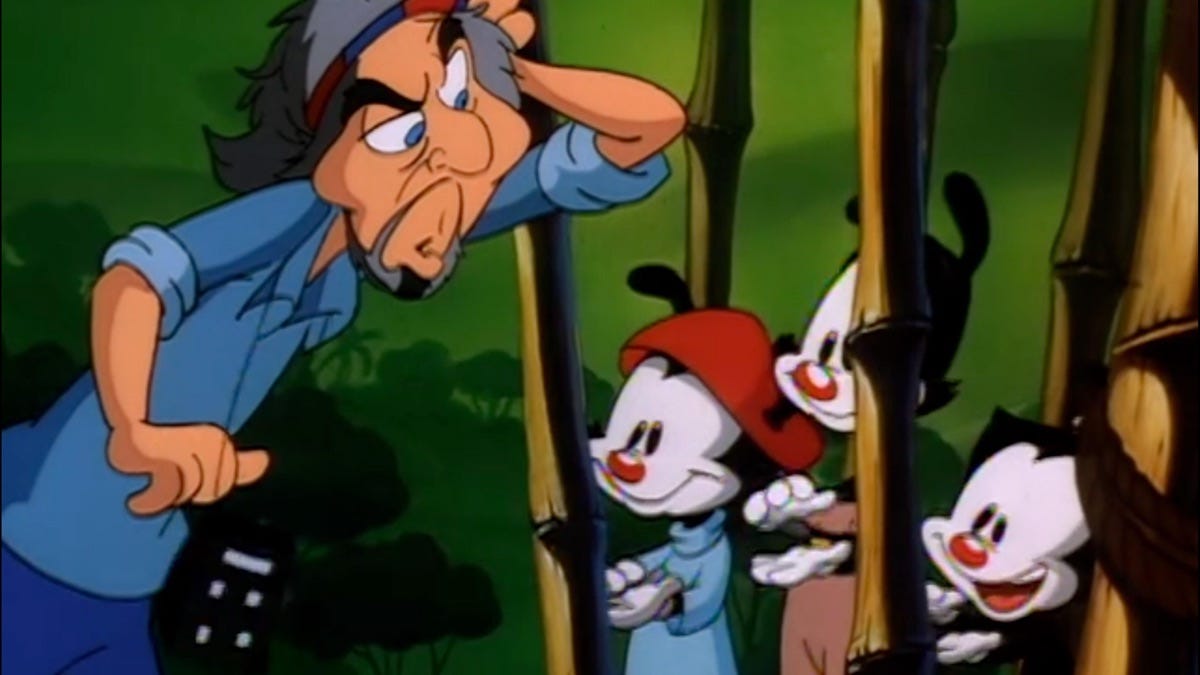
The first season of Animaniacs features a nine-minute cartoon called Hearts of Twilight. It opens with Thadeus Plotz, the CEO of Warner Bros, learning from two of his subordinates about the Director who’s locked himself in a soundstage, refusing contact with the outside world until he finishes his movie. Plotz needs to stop the Director, and all of the accountants he’s sent have been unsuccessful, so he tries a different approach and taps the Warners for this dangerous mission. Yakko, Wakko and Dot travel through the studio lot on a golf cart, witnessing the horror of tourists getting charged $27.50 for a tour of the studio. When they arrive at the soundstage, they are captured by the accountants, who have become disciples of the Director. Looking for a way to escape, Yakko tells the Director they can help him find an ending for his movie. (It involves a giant mallet.) Their mission completed, the siblings return home to their water tower.
Here’s what I found funny about this cartoon when I first watched it at the age of eleven: Yakko playing two paddleballs at once during moments of danger; the Director’s high-pitched, onomatopoeic screeching; Wakko’s recitation; the Director sitting in his chair and stuffing a doughnut into his mouth, the button of his jacket shooting off from his bulging gut. The intertextual hijinks, the conflation of different forms of creative hubris, went right over my head. Which was the idea. Animaniacs simply wanted me to know that, when it came to self-declared geniuses espousing their vision, the best response was laughter.
You probably noticed that the title of the cartoon refers to Hearts of Darkness, the documentary about Francis Ford Coppola’s nearly disastrous struggle to make Apocalypse Now, itself an adaptation of the Joseph Conrad novel Heart of Darkness. Martin Sheen, the star of the movie, suffered a heart attack during filming, monsoons destroyed the film’s sets, and worst of all, Coppola didn’t have an ending. He went months over schedule and millions of dollars over budget trying to figure out how to finish his Vietnam War epic. You’ll also recall that the plot of Apocalypse Now involves Captain Willard, played by Sheen, traveling by boat up a river in the jungle in order to find and terminate the mad Colonel Kurtz, played by Marlon Brando, who’s gone rogue and holed himself up in what looks like an abandoned set from Raiders of the Lost Ark. The story of Hearts of Twilight, then, is a combination of those two movies, the fictional and the documentary. The Warners even meet a cartoon Dennis Hopper, although he’s still not as crazy as the actual Dennis Hopper of the 1970s.
This blending of the two movies is clearest in the character of the Director. He’s trying to find an ending to his movie, like Coppola, while isolating himself in a distant compound and surrounding himself with disciples, like Brando playing Kurtz. He even looks like Brando, bald-headed and pot-bellied. When the Warners first meet him, he’s filming a monologue for his movie’s ending. “I saw a snail slithering across a railroad track, Ooey Gooey was his name . . .” he says. This is a spoof of a speech that Kurtz makes in Apocalypse Now, where he talks of seeing a snail crawl across a razor blade, and how this is “my dream, my nightmare.” Before the Director can finish his monologue, however, a fly buzzes into the frame, and he swallows it. “Ooh, I ate a bug! A bug I ate, with little wiiiiings!” he says. This is based on an outtake in Hearts of Darkness where Brando is extemporizing a lecture on the human propensity for bloodlust, before his face scrunches up and he coughs. “I swallowed a bug,” he says, arguably the finest line of dialogue he delivered in his entire career.
Two movies, two characters, fiction and fact, combined into one character. Not bad for a kids’ cartoon, huh?
If you’re a fan of the show, however, you’ve noticed that I left out what made the Director so funny in this cartoon. It’s this detail, I think, that really makes Hearts of Twilight a work of meta brilliance
The Director is a broad, knowing spoof of Jerry Lewis, particularly from The Nutty Professor era. (It’s likely that Lewis is best known to younger generations not through his actual performances, but through Prof. Frink, The Simpsons’ take on Lewis’ antic persona in that film. It’s meta all the way down.) He expresses himself in nonsensical exclamations, such as “Froinlaven!” The Dennis Hopper character even makes a joke on how he’s regarded as a genius by the French. I was dimly aware of this at the age of eleven, having seen clips of Lewis on TCM, but I didn’t think there was any reason why the Director was a spoof of Lewis in particular. I just thought it was funny.
Making the Director a send-up of Lewis was, in fact, an iteration of a long-running Hollywood legend. Later in his career, in a bid to recreate himself as a Serious Artist, Lewis wrote, directed and starred in a movie called The Day the Clown Cried. It was a Holocaust tragicomedy, the only entry in this particular subgenre. (Well, that and Life is Beautiful, which was a kind of spoof of Lewis’ movie.) In the film, Lewis plays a clown who’s supposed to entertain the children of a Nazi concentration camp. He goes through his usual routine of pratfalls and balloon animals while the children are led into the gas ovens. It sounds awful; is it actually that bad, or even worse?
No one knows. The movie was never released. Lewis took the master prints and kept them for reasons that still aren’t quite clear. Perhaps he thought his work was too pure for the public, like J.D. Salinger writing stories and storing them in a vault in his New Hampshire home. Maybe he sensed that the controversy that the film was sure to stir could have ended his career. Either way, it’s gone on to become one of the great mysteries in movie history, and Animaniacs tapped into it.
So: the Director in Hearts of Twilight is a triple portrait, of Francis Ford Coppola, Marlon Brando and Jerry Lewis. Three examples of creativity’s reach exceeding its grasp.
And how do the Warners escape the soundstage? As mentioned, Yakko tells the Director that he’ll give him an ending for his movie if he and his siblings can go free. Desperate, the Director agrees, thanking the “nice puppy boy with no eyebrows!” He stands in the middle of a soundstage, waiting for Yakko to yell ‘action.’ As soon as he does, a giant mallet crashes down from the left of the frame and flattens the Director. The cameraman tells Yakko the microphone was in the shot. They do it again, flattening the Director even further. He looks like a pancake. “The hurting, the hurting. Cut, print, that’s a wraaaap,” he says. The Warners go free.
What’s the lesson to be learned here? I have no idea. You’ll have to ask the Wheel of Morality.
So good. This illustrates so well how I, a millennial homeschooler, learned anything about anything in pop culture: always about four levels removed from the source material.
I know there's a cottage industry of pieces explaining THE HIDDEN SECRETS OF MILLENNIAL CARTOONS but this was, in fact, genuinely informative (and fun to read, vs ScreenRant non-style).
Feels like damning with faint praise to say the music video episode was the best Tiny Toons, though!